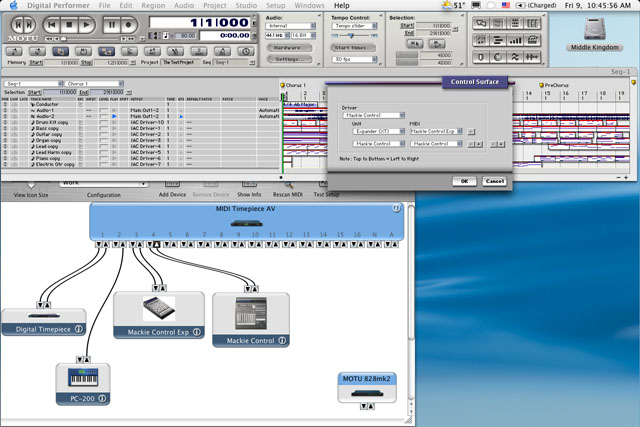
Mackie Control Drivers For Mac
HUI was the first controller from Mackie and is very old. The Mackie Control was at first a dedicated controller for Logic, and the front panel labels reflected this. Later versions called Mackie Control Universal (aka MCU) appeared once other software began supporting the Mackie Control protocol, which was originally developed by Mackie and Emagic specifically for Logic. The HUI was larger and bulkier than the MCU and was also a monitor controller, so it had audio ins and outs for connection between your DAW and your speakers.
Aug 13, 2019 When you install Microsoft Windows on your Mac, Boot Camp Assistant automatically opens the Boot Camp installer, which installs the latest Windows support software (drivers).If that doesn't happen, or you experience any of the following issues while using Windows on your Mac, follow the steps in this article. Emagic turned heads at the 2001 Frankfurt Musikmesse when they announced Logic Control, a desirable control surface for Logic designed in conjunction with Mackie that seemed to finally offer a serious project-studio-level control surface at a reasonable price. Logic Control.
The HUI also had a couple of mic preamps as well, so in the end it was a similar combinations of features to what you'd find on today's SSL Nucleus.The MCU communication protocol includes pretty much everything that the HUI had plus some further advances, and most DAW software supports MCU, whereas software that never had HUI support in the first place is probably never going to have it at this point since the hardware has been discontinued for many years. While the two formats are very similar they are NOT identical or compatible. If your software only supports MCU and not HUI, it will not work with a HUI hardware controller. There are TONS of HUI boxes on the street at this point and they can be bought for $300 or less in decent shape - but they are long discontinued so some repair parts may be scarce.The first MCU units were brown in color, like the HUI, and used conventional 5-pin MIDI to communicate with the DAW, so you needed to have a multi-port MIDI interface and associated cables in order to get it all working. The main unit was an 8-channel fader controller with transport and menu buttons.
The expansion units added 8 faders, and you could use (I think) three expansion units for a total of 32 faders. There was also a very slick unit called the C4 which added 32 knobs for direct control of plugins, and it had some very cool features as well - you could use the knobs to control track zooming and press the knobs to jump to any one of the first 32 markers in a session, etc.Later (and current) MCU units were silver in color, and had a built-in USB MIDI interface in the main unit.
This means that you can just plug in the main MCU unit to the computer with a simple USB cable, and then use 5-pin MIDI cables to connect up to 3 fader expansion units to the main unit for a total of 32 faders. For a short time, there was also a silver C4 unit, but it has now been discontinued. It is still possible to find used silver C4 units for sale from time to time, and you can even use the older brown C4 connected via 5-pin MIDI cables to the newer silver MCU master unit. Other than the color and the built-in USB MIDI interface on the silver MCU master, the brown and silver MCU units are the same, and although it might look ugly, you can mix and match them.Each MCU master or fader expansion unit has 8 knobs above the channel faders, and these can be used to edit plugin parameters. If you have multiple MCU units, then you'll be able to see more parameters of your plugin, up to 32 if three expansion units and a master are connected. It is NOT possible to 'split' the knobs to show parameters from more than one plugin at a time, but whatever plugin is selected for editing WILL 'spill' across as many knobs as you have channel faders.
The knobs can also be used to edit pan or send levels, and by pressing the 'flip' button the knobs and faders will swap positions so you can edit sends or plugin parameters from the faders instead of the knobs.The MCU communication protocol is used by many other hardware units, like the PreSonus FaderPort-8, and is open-source - this protocol is not likely to change or be discontinued any time soon. All in all, the MCU system is about the best there is for Logic, and even after all these years still holds up well when compared with EuCon, which is used by Avid controllers. EuCon has a few advantages but is NOT open-source and is not as widely adapted as MCU.All in all, an MCU controller is a safer and better bet than a HUI, but if you are getting a very cheap price on a HUI just check and make sure that your DAW software explicitly supports HUI protocol before plunking down the cash.Studio One definitely supports MCU, since PreSonus' own FaderPort-8 uses this protocol, but I didn't dig deep enough into their website to find out if Studio One explicitly supports HUI protocol.
You'll have to dig that info up for yourself! HUI was the first controller from Mackie and is very old. The Mackie Control was at first a dedicated controller for Logic, and the front panel labels reflected this. Later versions called Mackie Control Universal (aka MCU) appeared once other software began supporting the Mackie Control protocol, which was originally developed by Mackie and Emagic specifically for Logic. The HUI was larger and bulkier than the MCU and was also a monitor controller, so it had audio ins and outs for connection between your DAW and your speakers. The HUI also had a couple of mic preamps as well, so in the end it was a similar combinations of features to what you'd find on today's SSL Nucleus.The MCU communication protocol includes pretty much everything that the HUI had plus some further advances, and most DAW software supports MCU, whereas software that never had HUI support in the first place is probably never going to have it at this point since the hardware has been discontinued for many years.
While the two formats are very similar they are NOT identical or compatible. If your software only supports MCU and not HUI, it will not work with a HUI hardware controller. There are TONS of HUI boxes on the street at this point and they can be bought for $300 or less in decent shape - but they are long discontinued so some repair parts may be scarce.The first MCU units were brown in color, like the HUI, and used conventional 5-pin MIDI to communicate with the DAW, so you needed to have a multi-port MIDI interface and associated cables in order to get it all working. The main unit was an 8-channel fader controller with transport and menu buttons. The expansion units added 8 faders, and you could use (I think) three expansion units for a total of 32 faders.
There was also a very slick unit called the C4 which added 32 knobs for direct control of plugins, and it had some very cool features as well - you could use the knobs to control track zooming and press the knobs to jump to any one of the first 32 markers in a session, etc.Later (and current) MCU units were silver in color, and had a built-in USB MIDI interface in the main unit. This means that you can just plug in the main MCU unit to the computer with a simple USB cable, and then use 5-pin MIDI cables to connect up to 3 fader expansion units to the main unit for a total of 32 faders. For a short time, there was also a silver C4 unit, but it has now been discontinued. It is still possible to find used silver C4 units for sale from time to time, and you can even use the older brown C4 connected via 5-pin MIDI cables to the newer silver MCU master unit.
Other than the color and the built-in USB MIDI interface on the silver MCU master, the brown and silver MCU units are the same, and although it might look ugly, you can mix and match them.Each MCU master or fader expansion unit has 8 knobs above the channel faders, and these can be used to edit plugin parameters. If you have multiple MCU units, then you'll be able to see more parameters of your plugin, up to 32 if three expansion units and a master are connected.
It is NOT possible to 'split' the knobs to show parameters from more than one plugin at a time, but whatever plugin is selected for editing WILL 'spill' across as many knobs as you have channel faders. The knobs can also be used to edit pan or send levels, and by pressing the 'flip' button the knobs and faders will swap positions so you can edit sends or plugin parameters from the faders instead of the knobs.The MCU communication protocol is used by many other hardware units, like the PreSonus FaderPort-8, and is open-source - this protocol is not likely to change or be discontinued any time soon. All in all, the MCU system is about the best there is for Logic, and even after all these years still holds up well when compared with EuCon, which is used by Avid controllers. EuCon has a few advantages but is NOT open-source and is not as widely adapted as MCU.All in all, an MCU controller is a safer and better bet than a HUI, but if you are getting a very cheap price on a HUI just check and make sure that your DAW software explicitly supports HUI protocol before plunking down the cash.Studio One definitely supports MCU, since PreSonus' own FaderPort-8 uses this protocol, but I didn't dig deep enough into their website to find out if Studio One explicitly supports HUI protocol. You'll have to dig that info up for yourself! Awesome explanation.
Thank you very much for your lengthy and thorough response! One thing I am still unclear about though is what exactly the protocol is/does. Does it automatically map everything to the DAW, or is it more like Mackie's proprietary MIDI where you will have to map everything yourself etc?The unit I have been offered is the Mackie Baby HUI, which is the smaller footprint unit with 8 motorised faders and some other basic transport/pan/sends control.I will have a dig in the Studio One site now and, if necessary, shoot off a message to Presonus.Huge thanks again! Just had a look through the manual and found:Mackie Control/HUI Support (page 190)Studio One is optimized for use with Mackie Control and HUI-format devices, including Control Link Mapping and Send slot navigation, with the ability to scroll through, and select from the lists of available plugins and instruments, and their presets. You can also control various Channel and Track parameters such as Mute/Solo, and FX Bypass (EQ button). Further information can be found in the Mackie Control section. Awesome explanation.
Thank you very much for your lengthy and thorough response! One thing I am still unclear about though is what exactly the protocol is/does. Does it automatically map everything to the DAW, or is it more like Mackie's proprietary MIDI where you will have to map everything yourself etc?The unit I have been offered is the Mackie Baby HUI, which is the smaller footprint unit with 8 motorised faders and some other basic transport/pan/sends control.I will have a dig in the Studio One site now and, if necessary, shoot off a message to Presonus.Huge thanks again! Just had a look through the manual and found:Mackie Control/HUI Support (page 190)Studio One is optimized for use with Mackie Control and HUI-format devices, including Control Link Mapping and Send slot navigation, with the ability to scroll through, and select from the lists of available plugins and instruments, and their presets.
You can also control various Channel and Track parameters such as Mute/Solo, and FX Bypass (EQ button). Further information can be found in the Mackie Control section.
That's what I would have expected, so it looks like you're in luck. Since the HUI and MCU protocols are so similar, I'm not surprised that Studio One handles both - but since MCU protocol is newer (and 'better' - or at least more complete), plus the fact that the HUI has been out of production for so long, it is certainly possible that some newer DAW software will support MCU but won't support HUI. So don't be surprised someday down the line when Bigwig or Ableton or whatever does support MCU but won't see the HUI hardware. One reason I liked MCU over EuCon is because I'm a Logic user - and MCU was developed with the Logic team, and is 'baked in' to Logic. There are no drivers, 'control surface profile' files, or any other external stuff to deal with when using MCU devices with Logic.
This is not the case with EuCon devices or pretty much any other control surface. As soon as Logic boots up, it pings all of the MIDI ports to see if any MCU devices are powered up. When the devices receive the ping, they say hello to Logic and BOOM the devices are on-line. Going back fifteen years or so, the MCU devices never screwed with me in the slightest - and I have some old ones that actually have the Emagic logo on the front instead of the Mackie logo, and they all still work fine. Although I don't actually use them anymore (see below.).Contrast this to devices like the PreSonus FaderPort, which I have and use - although the unit is still in production and for sale, even this many years later they STILL don't have a native 64-bit version of the software or installer or whatever, which means you have to go through a pretty arcane process of opening the hood on the Logic application and manually dropping the FaderPort driver into the right location.
It does work, but it's a freaking joke that PreSonus can't get it together to fully support one of their longest-running hardware products in one of the most widely-used DAW programs. Every time you update Logic, you need to manually drop in the FaderPort driver INSIDE the Logic application itself. It's not hard, but it ain't up to modern specs at all. So I'm bearish on PreSonus in general.
I only use the FaderPort so I'll have hardware transport controls to jump to previous/next marker when I'm running Ableton as a ReWire slave behind Logic - when Ableton is in the foreground the FaderPort's previous/next marker buttons still work, and cause both applications to locate to the markers that are programmed into the Logic song without requiring to program identical markers into the Ableton song. So that's cool. But that's all I use it for really. Two buttons.For a long time I had a 24-fader MCU setup plus a C4 in each of my rooms, but these days I actually don't use my MCU units any more, as I find I'm actually faster with the trackball when editing plugins, and if I really do need to 'ride a fader' to write automation (which is basically never) then I have the FaderPort. By the time I open a plugin window, then look down at the C4 and try to figure out which knob corresponds to what on-screen control, I could have just edited the on-screen control with the trackball and moved on to the next problem. I never need to stare at a bank of 8 or 16 faders and manually balance a stack of backing vocal tracks or whatever. So I won't get back into big fader controllers until I can use them seamlessly for automation AND MIDI cc controller duties.
Apparently Trevor Morris has figured out a way to use the Avid S3, EuCon, and Plogue Bidule to accomplish this with Cubase, but that's just too fiddly for me. If and when a new version of Logic / EuCon / whatever appears that allows you to split or toggle a EuCon surface between track automation and MIDI cc use, then I may drag an Avid S3 in here and check it out - but I'm not holding my breath.For a minute I had Artist Control units, back before Avid bought Euphonix - it was a bit of a mess back then. Units would drop out of communication with Logic, the driver was fussy, and it was just one more thing to keep updated. I imagine it's a bit better now that Avid relies so heavily on EuCon to run their big S6 consoles, but I am still gun-shy after the debacles of the early years and my Artist Controls are long gone - I swapped two of them and an Arturia Origin hardware synth for a Dave Smith Pro-2 and some EuroRack modules. Good trade.One thing that prevents me from using hardware control surfaces, and that's lacking from ALL of the hardware control surface solutions I've ever seen is the ability to HIDE certain parameters at will. Say you've pulled up a plugin that has dozens (hundreds) of parameters, but you don't want to scroll past dozens of them to find the five parameters you actually want to control.
Plugins like Ozone or EXS24 are notorious for this - when editing EXS24 from a hardware surface, the first eight or nine 8-knob banks are occupied by the mod matrix sources and destinations! It's as if they literally never even tried to use the features they've implemented - it's so stupid and unusable that I have to wonder if anybody at headquarters has ever even tried it out once. You scroll past page after page of mod routings that no sane person would EVER try to edit from a hardware surface, and then, buried halfway through page ten or so is the knob for filter cutoff.
Then you scroll past a few more pages of useless parameters until you find envelope attack and release buried somewhere around page three thousand. Parameters like sources and destinations in a mod routing matrix are best edited on-screen using the pop up menus, where you can see ALL of the choices at once in the pop-up, instead of scrolling through the choices with a knob, trying to read the truncated 8-character abbreviations of things that are displayed clearly on screen. It's laughable. Once the thrill of a new shiny piece of hardware control surface wears off, and the actual usability can be assessed objectively, I always wind up saying, 'This sucks. Get this POS out of here.'
If developers listened to my suggestions (ha ha ha) then you'd be able to open a plugin window, hold a modifier key, and press down on the v-pot that corresponds to the parameter you wish to hide. That parameter would disappear and all following parameters would scroll one slot to the left to fill up the gap. Then you could just roll through all the parameter pages, pressing the v-pots to hide parameters you don't want, ending up with a shorter and more manageable list of parameters that spill across the knobs. With something like EXS24, I could eliminate dozens of parameters (those pesky mod matrix parameters) and wind up with maybe eight to sixteen that are actually useful to control from hardware. Ideally this 'hide list' would be saved globally, so that every time you pulled up that plugin you'd only see the knobs you want. Even better would be the ability to re-sort the order in which the plug parameters are displayed, so you could put filter cutoff in slot one, resonance in slot two, etc. Obviously you'd need a way to 'un-hide' all parameters to go back to the full set, but none of this is impossible - but I'm still not holding my breath waiting to see this feature in Logic or Cubase or ProTools or whatever.

I've been begging for this for more than fifteen years and no luck so far. Without this ability, using a hardware surface to edit plugins is kind of a joke for the plugins I use. Idt 92hd73e driver for mac. It's just way too slow compared to my speed with the trackball. One reason I liked MCU over EuCon is because I'm a Logic user - and MCU was developed with the Logic team, and is 'baked in' to Logic.
There are no drivers, 'control surface profile' files, or any other external stuff to deal with when using MCU devices with Logic. This is not the case with EuCon devices or pretty much any other control surface. As soon as Logic boots up, it pings all of the MIDI ports to see if any MCU devices are powered up. When the devices receive the ping, they say hello to Logic and BOOM the devices are on-line. Going back fifteen years or so, the MCU devices never screwed with me in the slightest - and I have some old ones that actually have the Emagic logo on the front instead of the Mackie logo, and they all still work fine. Although I don't actually use them anymore (see below.).Contrast this to devices like the PreSonus FaderPort, which I have and use - although the unit is still in production and for sale, even this many years later they STILL don't have a native 64-bit version of the software or installer or whatever, which means you have to go through a pretty arcane process of opening the hood on the Logic application and manually dropping the FaderPort driver into the right location.

It does work, but it's a freaking joke that PreSonus can't get it together to fully support one of their longest-running hardware products in one of the most widely-used DAW programs. Every time you update Logic, you need to manually drop in the FaderPort driver INSIDE the Logic application itself. It's not hard, but it ain't up to modern specs at all. So I'm bearish on PreSonus in general. I only use the FaderPort so I'll have hardware transport controls to jump to previous/next marker when I'm running Ableton as a ReWire slave behind Logic - when Ableton is in the foreground the FaderPort's previous/next marker buttons still work, and cause both applications to locate to the markers that are programmed into the Logic song without requiring to program identical markers into the Ableton song.
So that's cool. But that's all I use it for really. Two buttons.For a long time I had a 24-fader MCU setup plus a C4 in each of my rooms, but these days I actually don't use my MCU units any more, as I find I'm actually faster with the trackball when editing plugins, and if I really do need to 'ride a fader' to write automation (which is basically never) then I have the FaderPort. By the time I open a plugin window, then look down at the C4 and try to figure out which knob corresponds to what on-screen control, I could have just edited the on-screen control with the trackball and moved on to the next problem. I never need to stare at a bank of 8 or 16 faders and manually balance a stack of backing vocal tracks or whatever. So I won't get back into big fader controllers until I can use them seamlessly for automation AND MIDI cc controller duties. Apparently Trevor Morris has figured out a way to use the Avid S3, EuCon, and Plogue Bidule to accomplish this with Cubase, but that's just too fiddly for me.
If and when a new version of Logic / EuCon / whatever appears that allows you to split or toggle a EuCon surface between track automation and MIDI cc use, then I may drag an Avid S3 in here and check it out - but I'm not holding my breath.For a minute I had Artist Control units, back before Avid bought Euphonix - it was a bit of a mess back then. Units would drop out of communication with Logic, the driver was fussy, and it was just one more thing to keep updated.
I imagine it's a bit better now that Avid relies so heavily on EuCon to run their big S6 consoles, but I am still gun-shy after the debacles of the early years and my Artist Controls are long gone - I swapped two of them and an Arturia Origin hardware synth for a Dave Smith Pro-2 and some EuroRack modules. Good trade.One thing that prevents me from using hardware control surfaces, and that's lacking from ALL of the hardware control surface solutions I've ever seen is the ability to HIDE certain parameters at will. Say you've pulled up a plugin that has dozens (hundreds) of parameters, but you don't want to scroll past dozens of them to find the five parameters you actually want to control. Plugins like Ozone or EXS24 are notorious for this - when editing EXS24 from a hardware surface, the first eight or nine 8-knob banks are occupied by the mod matrix sources and destinations!
It's as if they literally never even tried to use the features they've implemented - it's so stupid and unusable that I have to wonder if anybody at headquarters has ever even tried it out once. You scroll past page after page of mod routings that no sane person would EVER try to edit from a hardware surface, and then, buried halfway through page ten or so is the knob for filter cutoff. Then you scroll past a few more pages of useless parameters until you find envelope attack and release buried somewhere around page three thousand. Parameters like sources and destinations in a mod routing matrix are best edited on-screen using the pop up menus, where you can see ALL of the choices at once in the pop-up, instead of scrolling through the choices with a knob, trying to read the truncated 8-character abbreviations of things that are displayed clearly on screen. It's laughable.
Once the thrill of a new shiny piece of hardware control surface wears off, and the actual usability can be assessed objectively, I always wind up saying, 'This sucks. Get this POS out of here.' If developers listened to my suggestions (ha ha ha) then you'd be able to open a plugin window, hold a modifier key, and press down on the v-pot that corresponds to the parameter you wish to hide. That parameter would disappear and all following parameters would scroll one slot to the left to fill up the gap. Then you could just roll through all the parameter pages, pressing the v-pots to hide parameters you don't want, ending up with a shorter and more manageable list of parameters that spill across the knobs.
With something like EXS24, I could eliminate dozens of parameters (those pesky mod matrix parameters) and wind up with maybe eight to sixteen that are actually useful to control from hardware. Ideally this 'hide list' would be saved globally, so that every time you pulled up that plugin you'd only see the knobs you want.
Even better would be the ability to re-sort the order in which the plug parameters are displayed, so you could put filter cutoff in slot one, resonance in slot two, etc. Obviously you'd need a way to 'un-hide' all parameters to go back to the full set, but none of this is impossible - but I'm still not holding my breath waiting to see this feature in Logic or Cubase or ProTools or whatever. I've been begging for this for more than fifteen years and no luck so far.
Without this ability, using a hardware surface to edit plugins is kind of a joke for the plugins I use. It's just way too slow compared to my speed with the trackball. Preaching to choir sir. I know this is an old post but the exact issue of trying to find some hardware controller solution is what lead me to this thread. I've been using Push and the integration is great but the ability to customize behavior is really lacking. I just keep thinking to myself 'It's 2018 for (insert deity of choice)s sake WHY isn't there better solution?!' PrEditor from Isotonik has been the best solution so far but I was having a bit of issues with version 1 functioning on my system.
Anyway, I imagine a day where there the modular controller that is fully assignable, displays the parameter names on led strips above every knob/ fader and you can customize the components in any arrangement you would like.
Mackie ProFX8v2 Series mixer provides a comprehensive live sound solution covering a huge range of applications. Delivering unmatched sound quality, ProFX8v2 features all-new Mackie Vita preamps, which are virtually noiseless and designed specifically for the highly-dynamic world of live sound.ProFX8v2 also includes the immensely powerful new ReadyFX effect engine, harnessing floating-point DSP to deliver 16 rich effects that elevate any performance. The ProFX8v2 no-compromise live sound toolkit includes a room-shaping GEQ, flexible I/O and a built-in USB interface for hassle-free recording/playback. Phone: (800) 898-3211 Warranty: All SRM, DLM, HD, iP and C Speakers, Reach, PPM Mixers, HRmk2 Studio Monitors: 3-year inclusive of electronics, 2-year drivers (where applicable), nontransferable;Thump, Freeplay, Onyx Mixers and Interfaces, DL, VLZ4, ProFX mixers, MRmk3 Studio Monitors, Big Knob, MCU Pro Series, SP260, FRS Series Amplifiers, Mixer Bags/Covers/Hardware, Loudspeaker Bags/Covers/Hardware: 1-year nontransferable;FreePlay Lithium Ion Battery: 90-day all inclusive, nontransferable;B-Stock items, 90 days. Copyright © 1996-2020 American Musical Supply, Inc. All rights reserved. American Musical Supply reserves the right to correct pricing and/or product specifications in the event of typographical errors found in our print catalog or on our website.
If a product is listed at an incorrect price due to such errors or because of inaccurate information received from a supplier, American Musical Supply shall have the right to refuse or cancel any orders placed, whether or not the order has been confirmed and your credit card charged. If your credit card has already been charged for the purchase and your order is canceled, American Musical Supply will issue a credit to your credit card account in the amount of the charge.